


The number of stocks advancing surpassed those declining among the S&P 500 index constituents on Friday after a 14-session streak of negative market breadth. Now, Ryan Detrick, chief market strategist at Carson Global, has predicted gains ahead, citing historical market data.
What Happened: Risk appetite returned to Wall Street on Friday, leading to a sigh of relief from investors. Detrick highlighted how the markets have performed after previous such streaks ended.
Record 14 days in a row of more declining stocks than advancing stocks for the S&P 500 ended on Friday.
Here’s what happened after previous long streaks ended. 💪 pic.twitter.com/WV6PU7juQF
— Ryan Detrick, CMT (@RyanDetrick) December 23, 2024
According to the data shared by him, over the past four decades, there have been only five other instances where the S&P 500 experienced a period of ten or more consecutive days of negative breadth. Additionally, the index was higher by an average of 17.9% a year later after all five times.
Going back 40 years, there have been five other times the S&P 500 had more decliners than advancers for 10 consecutive days or more.
A year later? Higher all five times and up 17.9% on avg. pic.twitter.com/eYCUpiz4PU
— Ryan Detrick, CMT (@RyanDetrick) December 23, 2024
The market breadth turned positive with 89% of the stocks rising on Friday as compared to only 4% on Wednesday. This divergence also led the index to be higher a year later by at least 92.3% of the time since 1985.
Less than 4% advancers on the S&P 500 on Wednesday, but 89% on Friday.
Previous times saw a flush and then major buying two days later?
Negative 1 and 3 mos later on avg, but higher a year later 12 out of 13 times (92.3%). pic.twitter.com/yqfV0tBFUV
— Ryan Detrick, CMT (@RyanDetrick) December 23, 2024
Why It Matters: The Personal Consumption Expenditure (PCE) price index, the Fed’s preferred inflation gauge, rose 2.4% year-over-year, below the anticipated 2.5%. Core PCE, which excludes volatile food and energy prices, also undershot expectations, climbing 2.8% instead of the projected 2.9%.
This unexpected cooling of inflation sparked a jubilant rally across all major indices on Friday. The S&P 500 surged 1.09%, with every sector contributing to the gains. Investors cheered the reprieve from persistent inflationary pressures.
The real estate sector led the charge, experiencing a sharp rebound after being particularly hard-hit by the Fed’s recent hawkish stance. Small-cap stocks, represented by the Russell 2000, also posted strong gains of 0.94%, buoyed by a significant recovery in regional banks.
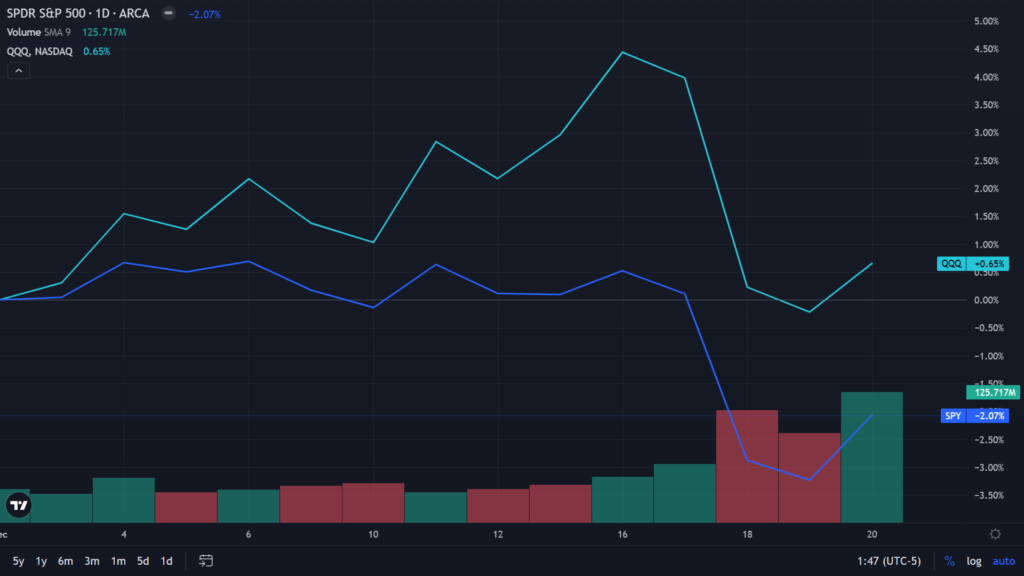
Price Action: The 14-day long streak entailing the trading days spanning from market close on Nov. 29 to Dec. 19, saw the SPDR S&P 500 ETF Trust SPY down by 2.07% and the Invesco QQQ Trust ETF QQQ up by 0.65%, according to Benzinga Pro data. On Friday, SPY advanced 1.20% and QQQ ended 0.87% higher.
Over the last month, the S&P 500 index is down by 0.94%, but year-to-date, it is up 25.05%.
The Nasdaq 100 index, on the other hand, is 2.33% over the last month and 28.68% year-to-date.
Read Next:
Image generated using Midjourney
Market News and Data brought to you by Benzinga APIs
© 2024 Benzinga.com. Benzinga does not provide investment advice. All rights reserved.