

- Unlevered after-tax NPV8 and IRR of US$5.0 billion and 24%, respectively
- Up to 70,000 tonnes per year of battery-quality lithium carbonate production
- Capital intensity of $49.9k per tonne with average annual cash operating cost of $4,226 per tonne
- Upgraded and upsized Mineral Resource with some of the highest lithium-in-brine concentrations reported in North America
- Potential to increase the scale and value through bromine and potash commercial opportunities
LEWISVILLE, Ark., Sept. 08, 2026 (GLOBE NEWSWIRE) — Smackover Lithium, the partnership between Standard Lithium Ltd. (“Standard Lithium” or the “Company”) (NYSE.A: SLI) (TSXV: SLI), through its subsidiaries, and Equinor, through subsidiaries of Equinor ASA, announced today the positive results of a Preliminary Economic Assessment (the “PEA”) for the Franklin project (“Franklin”, the “Project”, or the “Franklin Project”) in the northeast region of Texas, USA.
The PEA for the partnership’s first Project area in the East Texas region of the Smackover highlights the globally significant size and high quality of its brine position. It marks a key step towards the partnership’s goal of reaching well over 100,000 tonnes (“t”) of lithium chemical production per year in Texas through multiple phases and projects.
PEA Highlights:
- Robust lithium project economics. Unlevered after-tax net present value (“NPV”) of $5.0 billion, an internal rate of return (“IRR”) of 24.0%, and a 3.1-year payback period, assuming a discount rate of 8% and a lithium carbonate price of $22,400 per tonne (“/t”).
- Globally significant production scale. The PEA contemplates annual production capacity of up to 70,000 tonnes of battery-quality lithium carbonate and roughly 65,000 tonnes per annum (“tpa”) of average production over a 20-year modelled operating life, with an average lithium concentration of 515 mg/L. Initial production could begin in the early 2030’s with additional potential for a longer operating life and further expansion, though this is not modelled in the PEA.
- PEA leverages Definitive Feasibility Study (“DFS”) for the South West Arkansas Project (“SWA Project”). The SWA Project DFS was informed by an 18-month detailed front-end engineering design process. Due to the similarity of the brines within Standard Lithium’s suite of projects, it is possible to apply key elements of the SWA Project process flowsheet and costing to improve understanding and accelerate the PEA process for the Franklin Project.
- Competitive operating cost estimate. Average annual lithium cash operating costs of $4,226/t projected over the operating life, and average annual all-in costs, inclusive of cash operating cost, royalties, sustaining capital and closure costs, of $5,054/t (see Table 3).
- Capital requirements. Lithium initial capital cost estimate (“CAPEX”) of $3.5 billion, including contingencies of 20%. This estimate takes into consideration SWA Project costs and uses established methodologies and scaling factors that result in a capital intensity of $49,945/t and incorporates Standard Lithium’s continual Demonstration Plant learnings.
- Increased exploration activities support larger and improved Mineral Resource definition. Increased Mineral Resource size and a portion of the Mineral Resource converted from Inferred to Indicated as compared to the Maiden Inferred Resource Report (“MIRE”). The new Indicated Resource is 1.77 million tonnes lithium carbonate equivalent (“LCE”) at an average lithium concentration of 562 mg/L for 0.59 km3 of brine volume, while the upgraded Inferred Resource is 2.13 million tonnes LCE at an average lithium concentration of 572 mg/L for 0.70 km3 of brine volume. This represents a significant increase in total resource size. The PEA includes an Indicated and Inferred bromide Mineral Resource (ionized form of the commercial product bromine) of 2.66 and 3.15 million tonnes at an average bromide concentration of 4,483 and 4,501 mg/L, respectively, an increase and upgrade from the MIRE. There is also an Inferred potash (as potassium chloride) Mineral Resource of 15.06 million tonnes at an average potassium concentration of 11,291 mg/L (see Table 4).
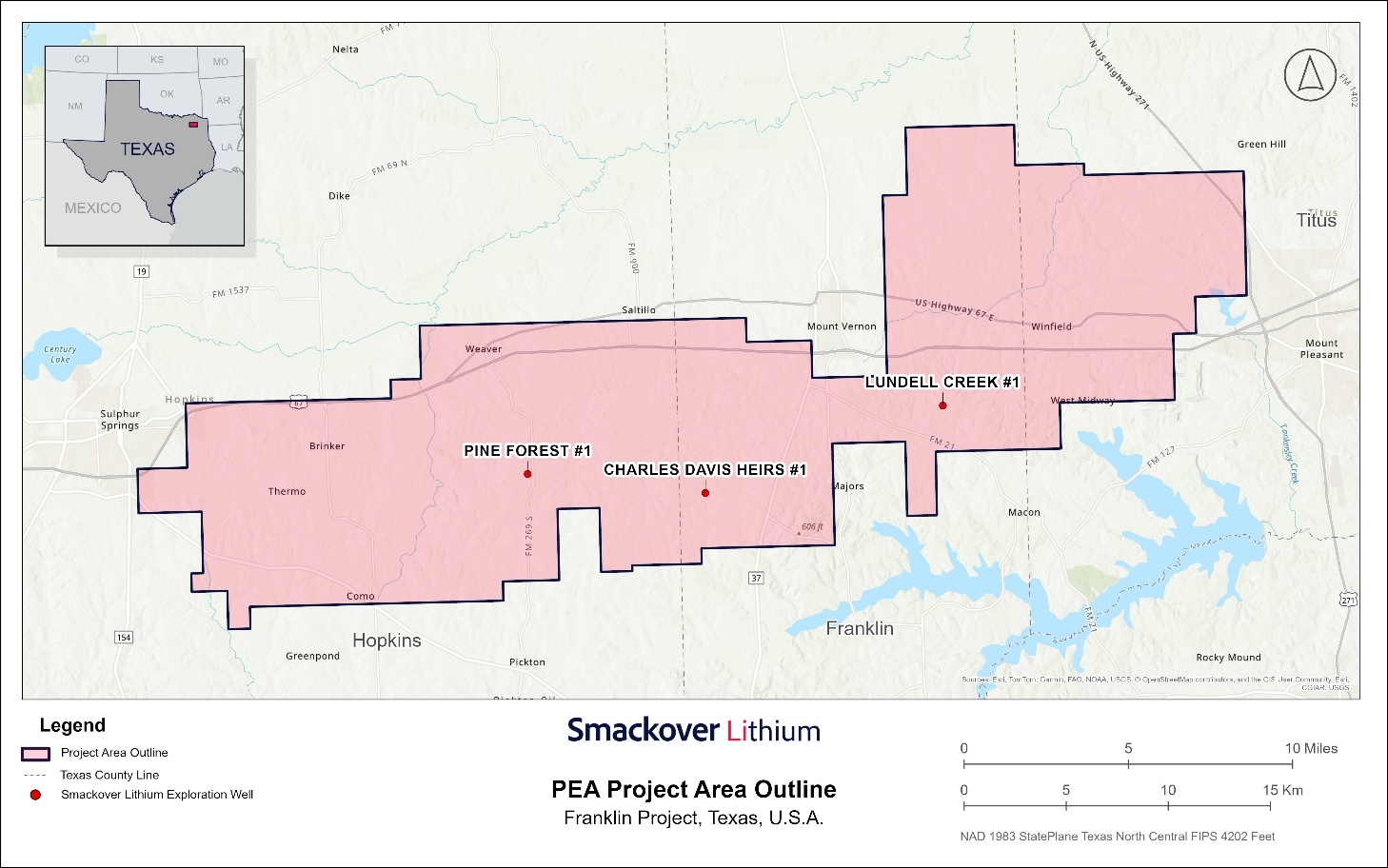
- Extensive brine mineral leasing for the Franklin Project. Brine mineral leasing has been ongoing since 2022 in the Project area now encompassing 44,541 hectares (110,064 acres), an increase of 37% from the 32,455 hectares (80,199 acres) highlighted in the MIRE (see Figure 1). A total 30,994 hectares (76,588 acres) gross mineral area has been leased to support the Mineral Resource.
- Additional value creation potential from bromine. The PEA also considers a scenario based on co-located bromine commercial opportunity of 50,000 tonnes per year.
- Possible future upside from potash. Potash was added to the U.S. Geological Survey Critical Mineral List in 2025. This PEA does not assume any potash recovery, production or economic contribution, but does highlight another possible source of future upside subject to technical, economic and market evaluation.
- All figures are in US dollars and all units are metric unless otherwise stated. All model outputs are expressed on a 100% ownership basis with no adjustments for financing assumptions. Standard Lithium’s economic interest in the Project is 55%. Mineral Resources have been reported in accordance with the 2014 Canadian Institute of Mining, Metallurgy and Petroleum (“CIM”) Definition Standards for Mineral Resources & Mineral Reserves (“CIM Definition Standard”).
Dr. Andy Robinson, President and COO of Standard Lithium stated, “The Franklin PEA demonstrates the strength of arguably one of the largest and highest-quality lithium brine resources in North America, supporting an attractive standalone lithium operation with additional potential value from bromine and potash. Continued Project definition through our resource development, processing expertise and mineral leasing activities has resulted in a meaningful increase and upgrade to the Mineral Resource while highlighting very attractive and robust Project economics. These latest results establish a strong foundation to advance the Franklin Project as the first of our planned large-scale critical minerals projects in East Texas and underscore the scale and national importance of the partnership’s broader resource position being developed in the region.”
Allison Kennedy Thurmond, VP for US Lithium at Equinor added, “Advancing the PEA for the Franklin Project is an important step in unlocking the broader lithium potential for our partnership across the region. We are proud of the team’s disciplined execution and hard work to realize the Project area’s potential. These results strengthen our confidence in the opportunity and position us well to progress the next phase of technical work.”
Project Overview
Smackover Lithium, a 55:45 owned partnership between Standard Lithium and Equinor, with Standard Lithium as the developer and operator, is seeking to develop a greenfield lithium extraction and chemicals production facility in the East Texas region of the Smackover Formation. The Franklin Project is its first defined project in East Texas.
Table 1 highlights the key operating and economic results of the Franklin Project PEA assuming lithium development and production only.
Table 1: PEA Highlights: Lithium [1]
| Lithium Facility and Wellfield | ||
| Annual Production Capacity of Lithium Carbonate | tpa [2] | 70,000 |
| Average Production over Modelled Plant Operating Life | tpa [2] | 64,600 |
| Modelled Plant Operating Life | years | 20 |
| Average Brine Flowrate over Modelled Plant Operating Life | bbl/d [3] | 455,000 |
| Lithium Concentration at Start of Production (Year 1) | mg/L | 562 |
| Average Lithium Concentration over Plant Operating Life | mg/L | 515 |
| Initial CAPEX | $ million | 3,496 [4] |
| Capital Intensity | $’000/t | 49.9 [5] |
| Average Annual Cash Operating Cost | $/t | 4,226 |
| Average Annual All-in Cost | $/t | 5,054 [6,7] |
| Lithium Carbonate Selling Price | $/t | 22,400 [8] |
| Discount Rate | % | 8 |
| NPV (Pre-Tax) | $ million | 5,924 |
| NPV (After-Tax) | $ million | 4,992 [9] |
| IRR (Pre-Tax) | % | 25.7 |
| IRR (After-Tax) | % | 24.0 [9] |
| Payback Period (Pre-Tax) | years | 3.0 |
| Payback Period (After-Tax) | years | 3.1 [9] |
| Notes: | |
| No bromine or potash is considered in this economic case. Any discrepancies in the totals are due to rounding. No inflation or escalation factor has been applied for the economic modelling | |
| [1] | The PEA is preliminary in nature and includes Inferred Mineral Resources that are considered too speculative to have the economic considerations applied to them that would enable them to be categorized as Mineral Reserves and there is no certainty that the PEA will be realized. |
| [2] | tpa denotes tonnes (1,000 kg) per annum. |
| [3] | bbl/d denotes barrels per day. 1 cubic metre per hour = 151 barrels per day. |
| [4] | Initial capital expenditures include 20% contingency. |
| [5] | Calculated as initial CAPEX divided by annual production capacity of lithium carbonate. |
| [6] | Non-GAAP financial measure that includes cash operating cost, royalties, sustaining capital and closure costs. |
| [7] | Royalties include gross revenue lithium royalty of 2.5%. Lithium royalties in Texas are established on a lease-by-lease basis and are agreed between the lessor and lessee. The exact royalties signed by Smackover Lithium are confidential and commercially sensitive, but 2.5% is used in the project economics as a representative rate suitable for the purposes of the PEA. |
| [8] | Selling price of battery-quality lithium carbonate based on a flat assumed price of $22,400/t over total Project lifetime. |
| [9] | Illustrative after-tax calculations based on assumption that the Project corporate entity is taxed as a stand-alone US C-Corporation and does not include the potential impact of currently held corporate net operating losses or credits, nor potential tax shields generated from financing. Assumes a U.S. Federal income tax rate of 21% and a State of Texas franchise tax rate of 0.59% (net of federal benefit). |
The Project’s economics are derived from inputs based on the annual production schedule as set forth in the PEA and summarized above. Over the 20-year modelled operating life, economic results are most sensitive to changes in the assumed selling price of lithium carbonate, as well as changes in the production schedule.
The Project area is contained in east Hopkins, Franklin, and west Titus counties. The centre of the Franklin Project is located approximately 4.5 km south of the city of Mount Vernon. The main access to the Project site is via east-west interstate Highway 30 connecting Texas to Arkansas. The Project area is also accessible by the state highways and the nation-wide rail network that passes through surrounding towns.
Brine mineral leasing has been ongoing since 2022 and the Mineral Resource underlies a total of 1,196 separate brine and brine-sourced mineral leases as of July 20, 2026. The 44,541 hectare (110,064 acre) Project area consists of 30,994 gross brine mineral hectares (76,588 gross brine mineral acres) leased by Smackover Lithium. Figure 1 shows a general outline of the Project area within which the lease boundaries occur.
Figure 1: Franklin Project Area Map
Processing Overview
Smackover Lithium is currently developing multiple projects in the Smackover Formation, including the SWA Project. The SWA Project is a direct lithium extraction (“DLE”) and lithium-only project that is well advanced in terms of metallurgical testing, has published a DFS and is preparing for a Final Investment Decision in late 2026.
The Franklin Project brine is sufficiently similar to the SWA Project brine from a metallurgical perspective. This means that the lithium process flowsheet for the Franklin Project will likely be similar to the SWA Project. The PEA is designed on this basis, including use of the same DLE technology, a critical part of the overall flowsheet. The Franklin Project is anticipated to produce a higher lithium recovery per brine volume processed because of the greater lithium concentration in the feed brine, resulting in potentially improved economics.
A third-party vendor with extensive expertise in the Smackover Formation was engaged for a treatability study of Franklin Project brine to provide a preliminary assessment of the brine compatibility with its lithium selective sorption process. The trials achieved the target lithium retention as well as the target sodium, potassium, calcium and magnesium rejection with the limited quantity of brine that was processed.
Production Plan and Assumptions
The PEA contemplates annual production capacity of up to 70,000 tonnes of battery-quality lithium carbonate and 1.29 million tonnes of total lithium carbonate production over a 20-year modelled operating life.
CAPEX
The initial capital cost for the wellfield operation and lithium processing facility is estimated at $3.5 billion. A contingency of 20% was applied to total direct, indirect and owner’s cost and estimates were prepared to an accuracy range of -30/+50% as appropriate for a PEA.
Table 2: Initial CAPEX Summary
| Category | CAPEX ($million) |
| Wellfield | 975 |
| Brine Preparation | 103 |
| Lithium Extraction | 325 |
| Lithium Purification / Concentration | 242 |
| Lithium Conversion | 205 |
| Lithium Product Handling | 75 |
| Utilities, Chemicals and Reagents | 58 |
| Infrastructure | 175 |
| Subtotal | $2,158 |
| Project Indirect Costs | 388 |
| Owner’s Costs | 367 |
| Contingencies [1] | 583 |
| Total Initial Lithium CAPEX | $3,496 |
| Notes: | |
| Totals may not sum due to rounding. | |
| [1] | 20% of total direct, indirect costs and owner’s cost. |
Operating Cost
The average cash operating cost over the life of the Project is $4,226/t of lithium carbonate produced. Average annual all-in cost, which includes cash operating cost, sustaining capital and closure costs, as well as known brine royalties, is $5,054/t.
Table 3: Operating Cost Summary
| Category | Avg. Annual Cost ($/t lithium carbonate) |
| Lithium Processing Facility | 3,283 |
| Wellfield & Subsurface | 679 |
| General & Administrative | 265 |
| Total Lithium Cash Operating Cost | $4,226 |
| Royalties [1] | 557 |
| Sustaining and Closure CAPEX | 270 |
| Total All-in Lithium Cost | $5,054 |
| Notes: | |
| Operating costs are calculated based on an average determined over the 20-year operating life. Totals may not sum due to rounding. | |
| [1] | Royalties include a gross revenue lithium royalty of 2.5%. See Note [7] in Table 1 for additional detail. |
Mineral Resource Assessment
The PEA incorporates an updated Mineral Resource estimate for the Franklin Project. Since completion of the MIRE, the partnership has acquired additional leases and concluded its latest well re-entry program, allowing for the increase of Mineral Resource size and conversion of a portion of the Mineral Resource from Inferred to Indicated. The Mineral Resource statement is shown in Table 4.
Table 4: Franklin Project Mineral Resource Estimates [1,2,3,4,6,7]
| Resource Category | Units | Indicated | Inferred | Inferred | Inferred |
| Smackover Formation | Upper Smackover | Upper Smackover | Middle Smackover | Total Smackover | |
| Gross Aquifer Volume | km3 | 7.84 | 8.70 | 17.16 | 25.86 |
| Net Aquifer Volume | km3 | 3.25 | 3.31 | 0.83 | 4.15 |
| Avg. Porosity | % | 18.21% | 17.95% | 12.6% | 16.86% |
| Brine Volume | km3 | 0.59 | 0.59 | 0.10 | 0.70 |
| Avg. Lithium Concentration | mg/L | 562 | 562 | 626 | 572 |
| Contained Lithium | kt | 333 | 334 | 66 | 400 |
| LCE [5] | kt | 1,771 | 1,779 | 349 | 2,128 |
| Avg. Bromide Concentration | mg/L | 4,483 | 4,483 | 4,600 | 4,501 |
| Contained Bromide | kt | 2,655 | 2,666 | 482 | 3,148 |
| Avg. Potassium Concentration | mg/L | NA [8] | 11,096 | 12,400 | 11,291 |
| Contained Potassium | kt | NA [8] | 6,597 | 1,299 | 7,896 |
| Contained Potassium Chloride (Potash) [5] | kt | NA [8] | 12,579 | 2,477 | 15,056 |
| Notes: | |
| Numbers may not sum due to rounding. | |
| [1] | The effective date of the Mineral Resource is July 20, 2026. The Qualified Person for the Mineral Resource is Randal Brush, P.E., an employee of Haas & Cobb Petroleum Consultants. |
| [2] | Mineral Resources were prepared in accordance with 2019 CIM Estimation of Mineral Resources and Mineral Reserves Best Practice Guidelines, CIM Leading Practice Guidelines for Sedimentary Basin and Geothermal Brine-Hosted Lithium Mineral Resources and Mineral Reserves Estimation and are reported in accordance with CIM Definition Standards. |
| [3] | Mineral Resources are not Mineral Reserves and do not have demonstrated economic viability. There is no certainty that all or any part of a Mineral Resource will ever be converted into a Mineral Reserve. The estimate of Mineral Resources may be materially affected by geology, environment, permitting, legal, title, taxation, socio-political, marketing, or other relevant issues. |
| [4] | The Mineral Resource estimate is reported using a cutoff of 6.0% porosity (net aquifer) and 100 mg/L lithium using the following assumptions: brine extraction from production wells and direct lithium extraction processing technology, lithium carbonate price of $22,400/t, twenty-year operating costs of $5,461 million, brine production volume of 528 million m3, lithium process recovery of 89.25% and 2.5% royalty on gross revenue on lithium production. |
| [5] | Lithium has been converted to LCE by a conversion factor of 5.323 and potassium has been converted to potash by a conversion factor of 1.91. |
| [6] | The lithium, bromide, and potassium resources present in the Upper Smackover and Middle Smackover intervals were estimated based on the 30,994 hectare gross Smackover Lithium leased mineral area within the 44,541 hectare Project area. |
| [7] | The mineral concentration values for the Upper Smackover interval are the average of the three exploration wells from samples collected in 2025/2026. The mineral concentration values for the Middle Smackover interval are the average sample values collected in 2023 from a single exploration well. |
| [8] | Potassium Mineral Resources are limited to the Inferred category because the potassium recovery process still requires development. In addition, capital and operating cost studies have not yet been conducted that would permit evaluation of the economic viability of the deposit with regard to potassium. Therefore, there are no potassium Mineral Resource estimates associated with the Indicated Resource area of the Upper Smackover interval. |
Permitting and Environmental Considerations
Considerations include obtaining and compliance with required permits, obtaining relevant baseline information for permitting, management of waste, water management and closure. A nexus for National Environmental Policy Act (NEPA) action at the site is not anticipated (no federal funding, no federal land); however, final determination can not be made until baseline data has been collected and Project definition is generally completed.
The Project area has a long history of hydrocarbon development associated with the Smackover Formation, and extensive oil and gas infrastructure remains present throughout the region. Emerging lithium and critical mineral development associated with the Smackover Formation represents a potential new economic sector for the region.
Next Steps and Recommendations
The principal recommendation of the PEA is to advance the Franklin Project to a Preliminary Feasibility Study (“PFS”), which is targeted for completion in 2027.
To facilitate the maturation and definition of a PFS, the partnership will look to refine the characteristics of the Upper and Middle Smackover Formation aquifers and brine chemistry.
The partnership will continue to conduct DLE testing of the Project brine, leveraging insights gained at Standard Lithium’s Demonstration Plant, as well as at the SWA Project. The partnership anticipates further evaluating potential commercial opportunities for bromine and potash.
Qualified Persons
The following authors of the PEA are qualified persons for the purposes of National Instrument 43-101 – Standards of Disclosure for Mineral Projects (“NI 43-101”) and the PEA-related information in this news release has been prepared under the supervision of and approved by them:
Mr. Randal M. Brush, P.E., a Senior Engineering Advisor at Haas & Cobb Petroleum Consultants; Mr. Robert E. Williams, PG, CPG, a Principal Geologist at Haas & Cobb Petroleum Consultants; Mr. Marek Dworzanowski, EUR ING and CEng, a consulting metallurgical engineer; Mr. Randal Huffsmith, P.E., a Senior Vice President, Business Development at WSP; Mr. Ibrahim Karajeh, P.Eng., a Principal, Design Services Leader at WSP; Mr. Mayooran Somanathan, P.Eng., is a Principal Metallurgical and Special Process Engineer at WSP; and Piers Wendlandt, P.E., Vice President, Mining Engineer at WSP.
Each of Mr. Brush, Mr. Williams, Mr. Dworzanowski, Mr. Huffsmith, Mr. Karajeh, Mr. Somanathan and Mr. Wendlandt have reviewed and approved the technical information contained in this news release related to the PEA and are considered to be “independent” of Standard Lithium and the Franklin Project for purposes of NI 43-101.
Additional scientific and technical information in this news release not specific to the PEA has been prepared under the supervision of, and approved by, Stephen Ross, P. Geo., the Company’s Vice President of Resource Development, a Qualified Person for the purposes of NI 43-101.
The scientific and technical information contained in the PEA and this news release is supported by an independent NI 43-101 Technical Report (the “Technical Report”). The Company intends to file the Technical Report on SEDAR+ within the 45-day period prescribed by NI 43-101. The Technical Report is expected to support the disclosure contained in the PEA and this news release and is not anticipated to contain any material differences from the PEA and the information presented herein. Readers are encouraged to review the Technical Report in its entirety once filed, including the assumptions, qualifications and risk factors underlying the study results.
About Smackover Lithium
Smackover Lithium is a partnership between Standard Lithium and Equinor, through subsidiaries of Equinor ASA. Formed in May 2024, Smackover Lithium is developing multiple DLE projects in Southwest Arkansas and East Texas. Standard Lithium owns a 55% interest and Equinor holds the remaining 45% interest in the projects, with Standard Lithium maintaining operatorship.
About Standard Lithium
Standard Lithium is a leading near-commercial lithium development company focused on the sustainable development of a portfolio of large, high-grade lithium-brine properties in the United States. The Company prioritizes projects characterized by high-grade resources, robust infrastructure, skilled labor, and streamlined permitting. Standard Lithium aims to achieve sustainable, commercial-scale lithium production via the application of a scalable and fully integrated DLE and purification process. The Company’s flagship projects are in the Smackover Formation, an attractive lithium brine asset, focused in Arkansas and Texas. In partnership with global energy leader Equinor, Standard Lithium is advancing the SWA Project, a greenfield project located in southern Arkansas, and actively advancing a promising lithium brine resource position in East Texas, including the highest known lithium brine grade project in North America, the Franklin Project.
Standard Lithium trades on both the TSX Venture Exchange (“TSXV”) and the NYSE American under the symbol “SLI”. Visit the Company’s website at www.standardlithium.com for more information.
About Equinor
Equinor is an international energy company committed to long-term value creation in a low-carbon future. Equinor’s portfolio of projects encompasses oil and gas, renewables, and low-carbon solutions, with an ambition of becoming a net-zero energy company by 2050. Headquartered in Norway, Equinor is the leading operator on the Norwegian continental shelf and has offices in more than 20 countries worldwide. Equinor’s partnership with Standard Lithium to mature DLE projects builds on its broad US energy portfolio of oil and gas, offshore wind, low carbon solutions, and battery storage projects.
For more information on Equinor in the U.S., please visit: Equinor in the US – Equinor.
Investor Inquiries
Daniel Rosen
+1 604 409 8154
[email protected]
Media Inquiries
Use of Non-GAAP Measures
Certain financial measures referred to in this news release are not measures recognized under International Financial Reporting Standards (“IFRS”) and are referred to as non-GAAP financial measures or ratios. These measures have no standardized meaning under IFRS and may not be comparable to similar measures presented by other companies. The definitions established and calculations performed by the Company are based on management’s reasonable judgement and are consistently applied. These measures are intended to provide additional information and should not be considered in isolation or as a substitute for measures prepared in accordance with IFRS.
The non-GAAP financial measure used in this news release and common to the lithium industry is all-in cost per tonne.
All-in cost per tonne is a non-GAAP financial measure and has no standardized meaning under IFRS Accounting Standards and may not be comparable to similar measures used by other issuers. As the Franklin Project is not in production, the Company does not have historical non-GAAP financial measures nor historical comparable measures under IFRS, and therefore the foregoing prospective non-GAAP financial measures or ratios may not be reconciled to the nearest comparable measures under IFRS.
Cautionary Note Regarding Forward-Looking Statements
Neither the TSXV nor its Regulation Services Provider (as that term is defined in policies of the TSXV) accepts responsibility for the adequacy or accuracy of this release.
This news release may contain certain “Forward-Looking Statements” within the meaning of the United States Private Securities Litigation Reform Act of 1995 and applicable Canadian securities laws. Forward-looking statements in this news release include, but are not limited to, the Company’s expectations and estimates with respect to: the economic and scoping-level parameters of the PEA and the Franklin Project; the anticipated timeline for completion of the Technical Report and any future PFS; the PEA’s ability to successfully leverage the SWA Project DFS; mineral resource estimates; the cost and timing of any development of the Franklin Project; the proposed mine plan and mining methods; mining recoveries; processing method and rates; potential value of bromine production and potash at the Franklin Project; production rates; projected recovery rates; infrastructure requirements and synergies; continued DLE testing of Project brine; the partnership’s ability to leverage insights gained at the Demonstration Plant and SWA Project; energy sources; capital, operating and sustaining cost estimates, including CAPEX, operating cost, IRR and NPV; the projected life of mine and other expected attributes of the Franklin Project, including expected ability to produce higher lithium recovery than the SWA Project because of the greater lithium concentration in its feed brine; future lithium prices; the timing of any engineering, environmental assessment or consultation processes; changes to the Franklin Project configuration that may be requested as a result of stakeholder or government input; government regulations and permitting timelines; access to the Franklin Project and lodging; water management; estimates of reclamation obligations and closure costs; requirements for additional capital; environmental risks; future drill programs, including specifically at the Franklin project; and general business and economic conditions.
Statements relating to “mineral resources” are deemed to be forward-looking statements, as they involve the implied assessment, based on certain estimates and assumptions that the mineral resources described can be profitably produced in the future. Generally, forward-looking statements can be identified using forward-looking terminology. Wherever possible, words such as “may”, “will”, “should”, “could”, “expect”, “plan”, “target”, “forecast”, “schedule”, “prospective”, “envision”, “continue”, “intend”, “assume”, “anticipate”, “believe”, “estimate”, “budget”, “predict”, “project” or “potential” or the negative or other variations of these words, or similar words or phrases, have been used to identify these forward-looking statements. These statements reflect management’s current beliefs and are based on information currently available to management as at the date hereof.
All statements other than statements of historical fact may be forward-looking statements. Forward-looking statements involve significant risk, uncertainties and assumptions. Many factors could cause actual results, performance or achievements to differ materially from the results discussed or implied in the forward-looking statements. Such factors include, among other things: risks related to the inherent uncertainties regarding cost estimates; the use of non-GAAP measures in financial performance accounting; changes in commodity and lithium prices; currency fluctuation; financing; unanticipated resource grades and process recoveries; infrastructure; results of future exploration activities; cost overruns; availability of materials and equipment; timeliness of government approvals; political risk and related economic risk; unanticipated environmental impact on operations; and risks associated with executing the Company’s plans and intentions. These factors should be considered carefully, and readers should not place undue reliance on the forward-looking statements. Although the forward-looking statements contained in this news release are based upon what management believes to be reasonable assumptions, the Company cannot assure readers that actual results will be consistent with these forward-looking statements. Additionally, while the Company has attempted to identify important factors that could cause actual results to differ materially from those contained in forward-looking statements, there may be other factors that cause results not to be as anticipated, estimated or intended. These forward-looking statements are made as of the date of this news release, and the Company assumes no obligation to update or revise them to reflect new events or circumstances, except as required by law.
A photo accompanying this announcement is available at https://www.globenewswire.com/NewsRoom/AttachmentNg/1b9c12e7-a1a0-41ed-8974-564590f2d11f